
Captain’s Log, Stardate 2025.0204.
After a most rejuvenating stasis cycle – known to Earthlings as a “good night’s sleep” – I awoke at precisely 0800 hours, ready for the day’s challenges. A swift sonic shower (well, a standard Earth shower, but it did the job) prepared me for my next mission: to confront the formidable “Full English Breakfast.” 😋
This was the map overview from the third day.

My first intergalactic spot was The Bankside Café. An unbelievable and historic café. The second was the incredible – Imperial War Museum (part 1) – and the last place visited that day was the Tower of London (part 2), an iconic castle.

Firstly, I spent the entire day on foot without taking the underground or buses. For that, I needed a gorgeous breakfast! This meal possesses the power to energize even the most weariest explorers, boasting eggs, sausages, bacon, beans, and other mysterious provisions that might perplex an intergalactic palate. But fear not, my crew (or readers) – armed with a fork in one hand and a curious sense of adventure in the other, I approached this culinary behemoth, determined to earn my place among Earth’s breakfast champions.
However, if you haven’t read the previous post about my London Adventure, click the link below.
Leaving The Walrus Bar & Hostel at 172 Westminster Bridge Road, I turned left onto Lower Marsh and continued straight for 6 minutes. I cross Waterloo Road, then headed to The Cut. After walking approximately 300 meters (0.2 miles), I turned left onto Hatfields, and continued to number 4, where I found The Bankside Café.
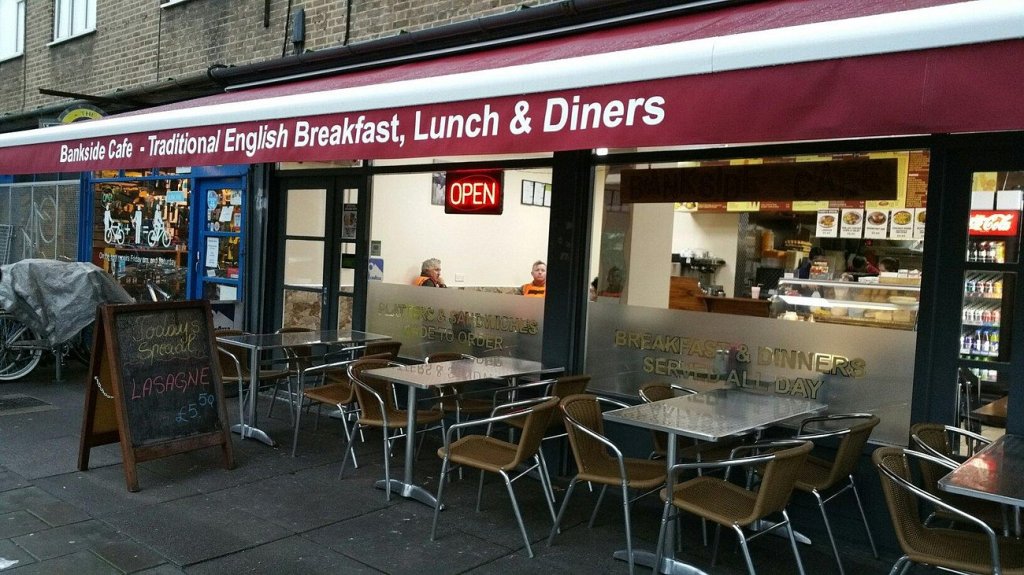
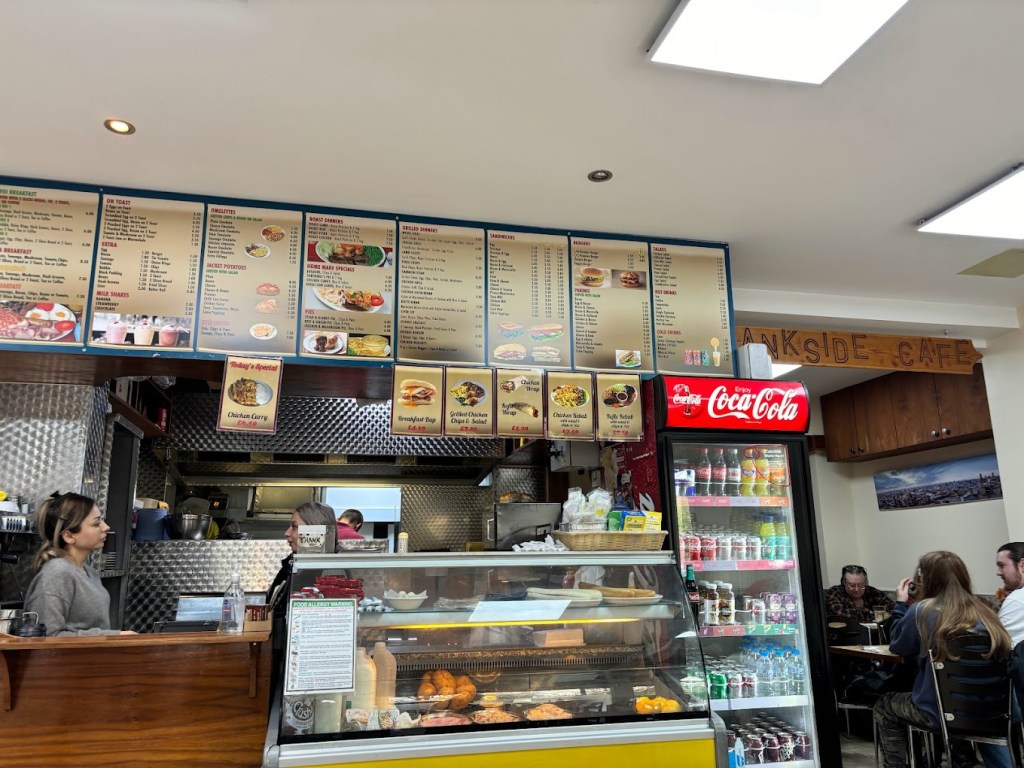

This was the biggest breakfast I’d ever had. 😅
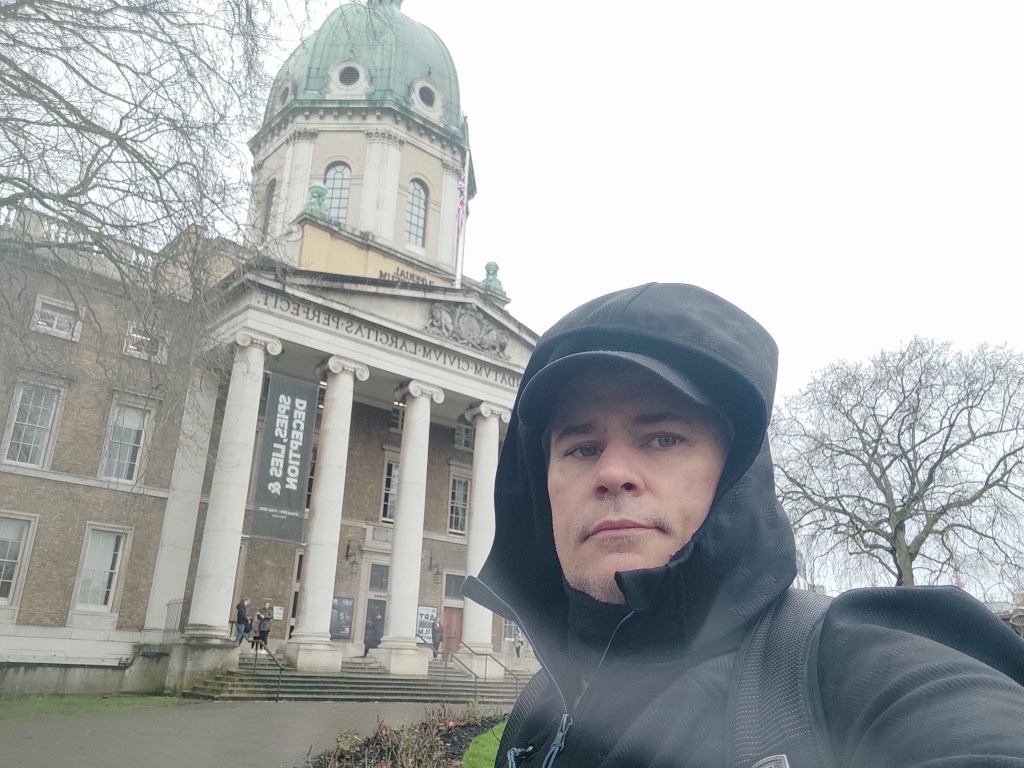
After eating, I headed to the Imperial War Museum – the world’s leading museum of war and conflict – on Lambeth Road.
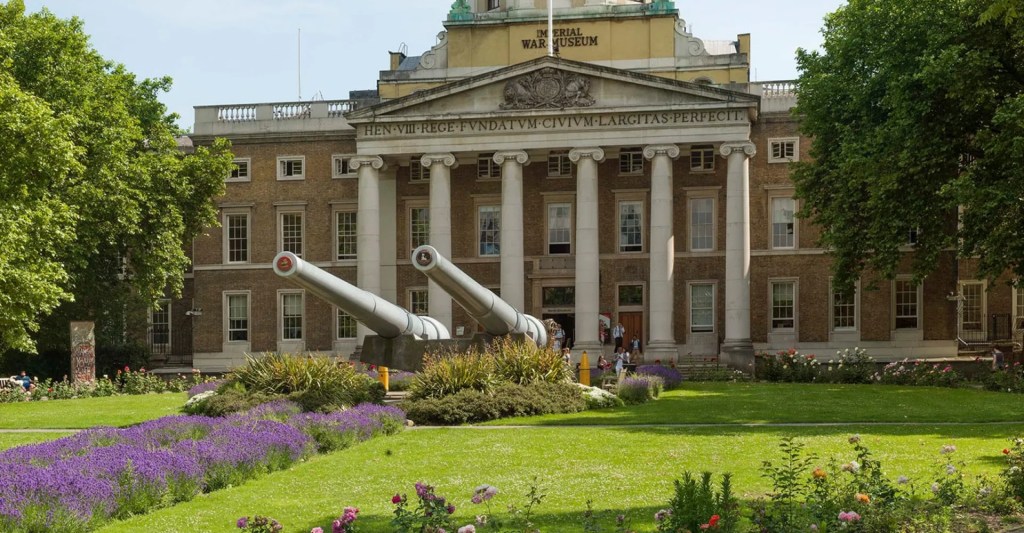
Unfortunately, the weather was not good, as shown in the picture above. 🤭😥
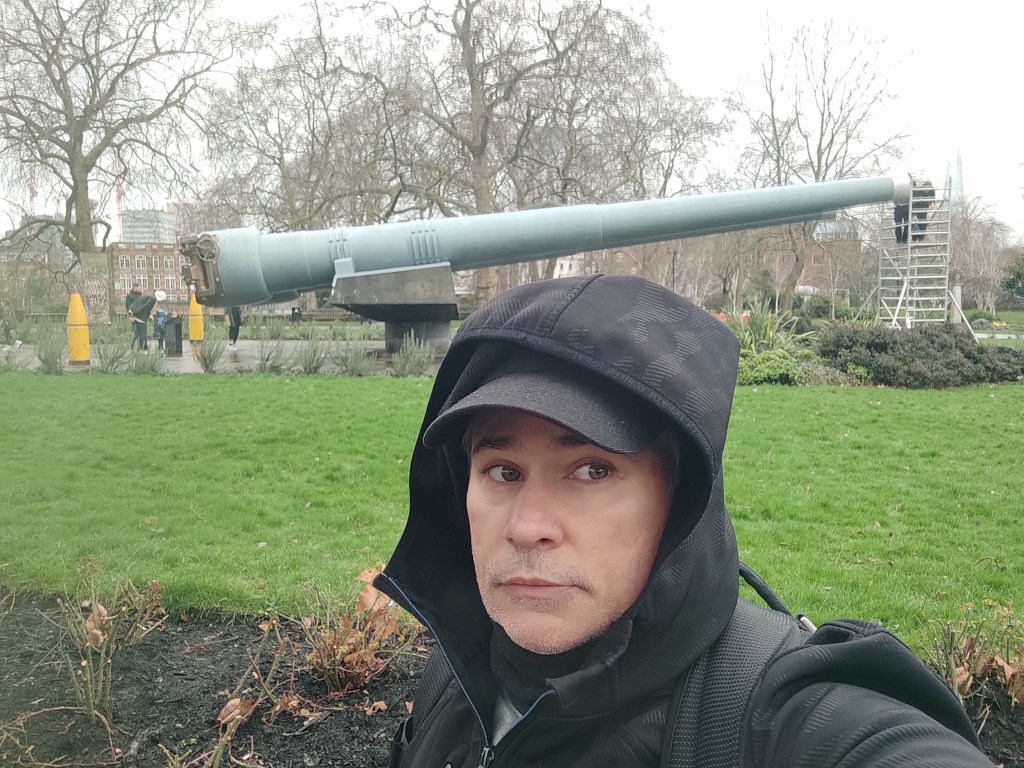
The two big weapons at the front of the Imperial War Museum (IWM) in London are 15-inch naval guns from British warships. The left gun was mounted on HMS Ramillies, a Royal Navy battleship launched in 1916. The one on the right was originally on HMS Resolution and was later used on HMS Roberts, a monitor-class warship.
Each gun weighs approximately 100 tons and could fire a 1,900-pound shell up to 16.75 miles away.
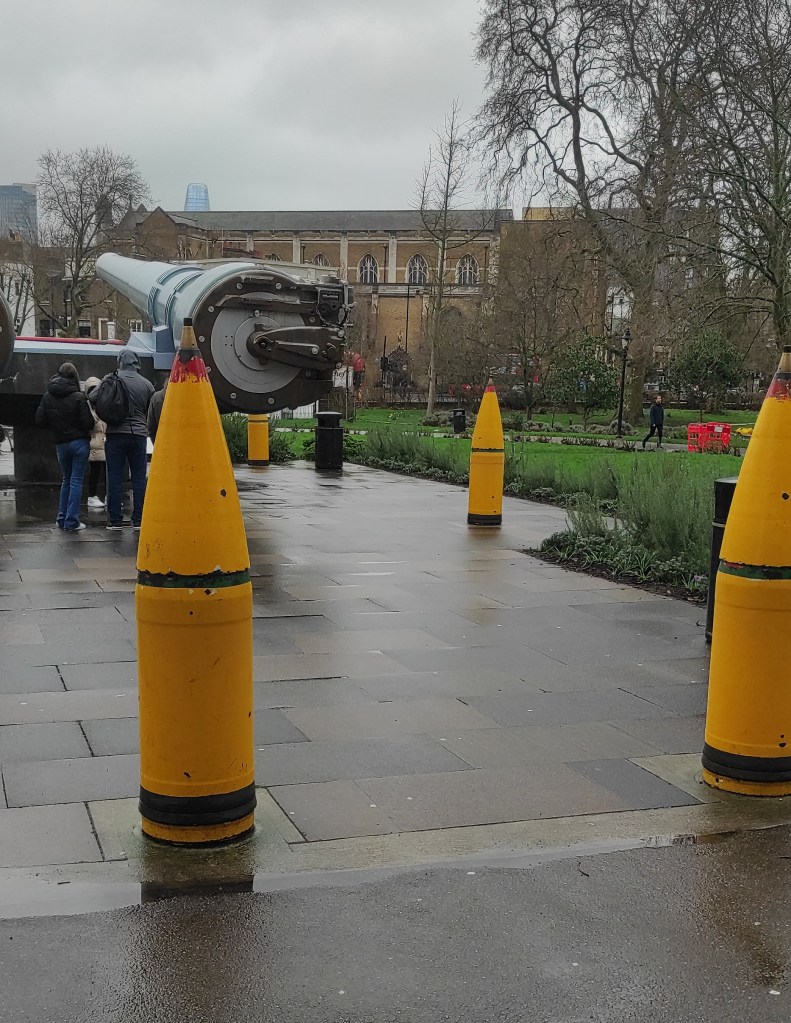
The 15-inch naval guns at the Imperial War Museum fired 15-inch (381 mm) shells, which were massive in size and destructive power.
Projectile Specifications:
- Weight: Around 1,900 lbs (862 kg)
- Length: Approximately 5 ft (1.5 m)
- Caliber: 15 inches (381 mm)
- Range: Up to 16.75 miles (27 km)
- Types:
- Armor-Piercing (AP): Designed to penetrate enemy battleships.
- High-Explosive (HE): Used against softer targets like fortifications and land targets.
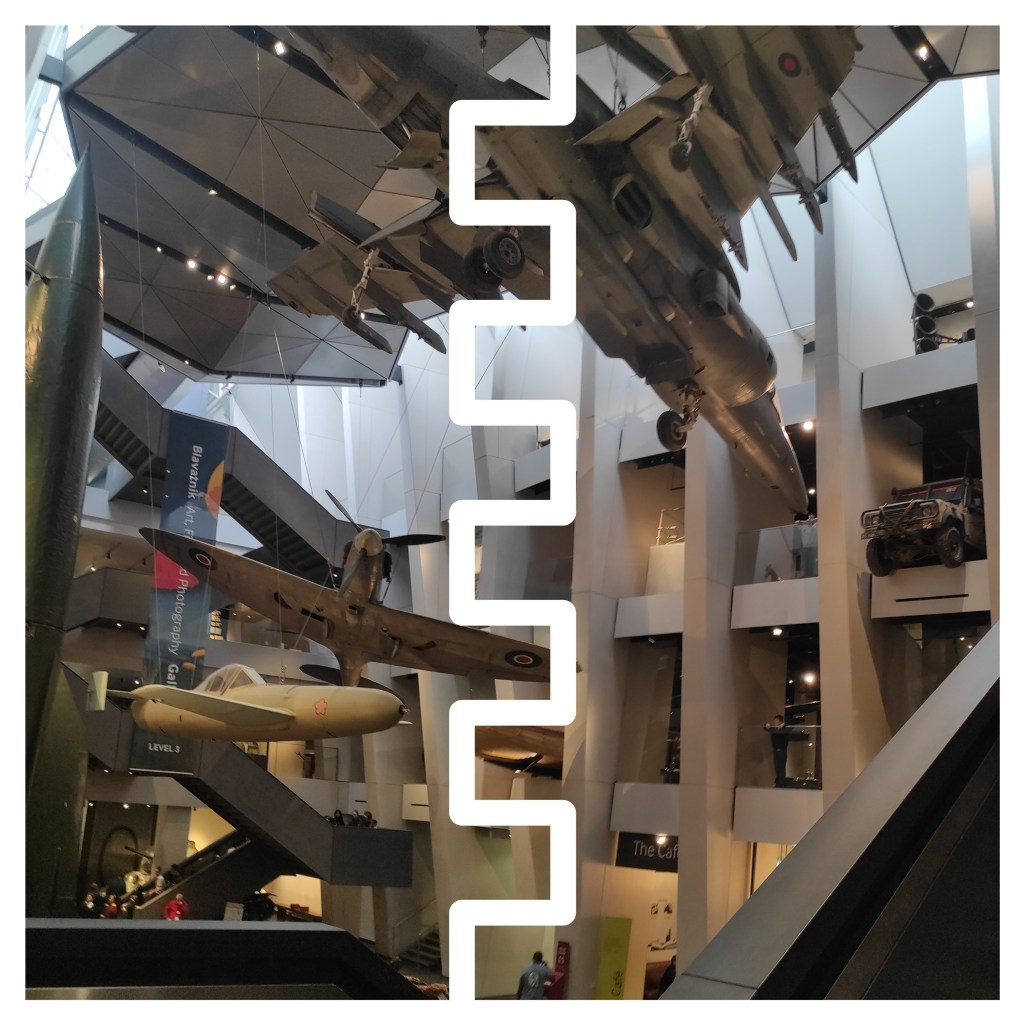
Inside the Museum is fantastic. As you walk further into the museum, the main entrance leads you into a vast atrium, where several war artefacts, aircraft, and vehicles are displayed.
T-34 – Soviet tank – Second World War and Arab-Israeli War.
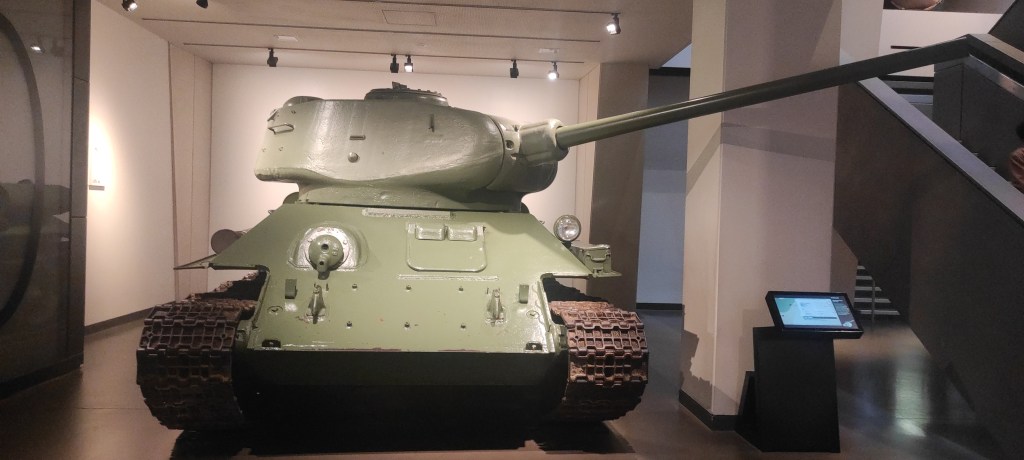
A Soviet tank design (above) was built in 1954. This tank was built in Czechoslovakia. It was sold to Egypt and captured by Israeli forces during the 1973 Arab-Israeli War.
Mitsubishi A6 Zero – A dominant aircraft of the first half of the war
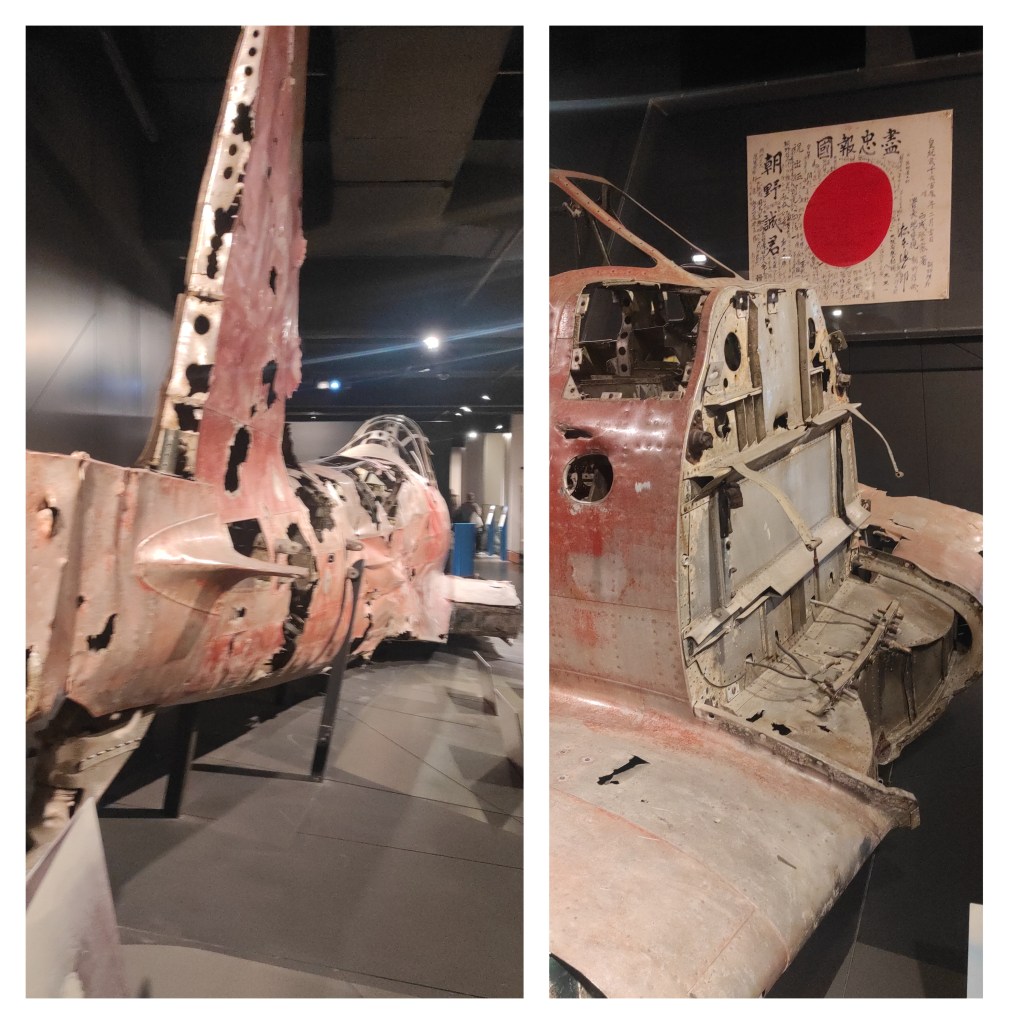
Japanese Kamikaze aircraft (above) were suicide attack aircraft used by Japan during World War II, especially in the Pacific Theater. Pilots, known as kamikaze (meaning “divine wind”), deliberately crashed their planes – often loaded with explosives – into enemy ships to cause maximum destruction. This tactic became more common in 1944–1945, as Japan faced increasing losses.
How It Worked:
1. Young, often inexperienced pilots were trained for one-way missions.
2. Planes were lightly armoured but loaded with explosives to maximize damage.
3. Squadrons of kamikaze pilots would take off from bases, usually in Japan or occupied islands.
4. They targeted U.S. Navy ships, diving at full speed to crash into them.
5. Some ships were sunk or heavily damaged, but the tactic didn’t stop the Allied advance.

This image above is an example of an aircraft destroyed by Anti-Aircraft Guns. It is a rapid-firing gun to shoot down incoming planes. Badly damaged in 1943 during combat over the remote Marshall Islands, in the Pacific Ocean, it was left a decaying wreck until found 50 years after the end of the Second World War.
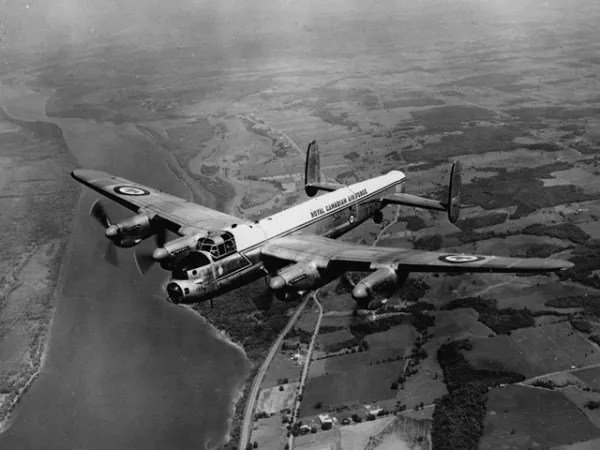
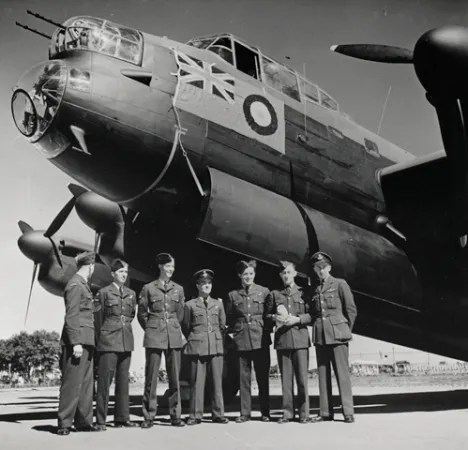
Avro 683 Lancaster Mk 1 – BritishHeavy bomber powered by four Rolls-Royce Merlin engines.

Delivered to 467 Squadron Royal Australian Air Force, based at Bottesford, Lincolnshire between November 1943 and June 1944. Took part in 49 sorties over enemy territory during 1943 – 1944. Later transferred to 1651 Heavy Conversion Unit at Woolfox Lodge. Used for training Aircrews. Finally struck off charge on 4 October 1945. Full history to be found in ‘We Flew Old Fred – The Fox’ by Arnold Easton (image below).

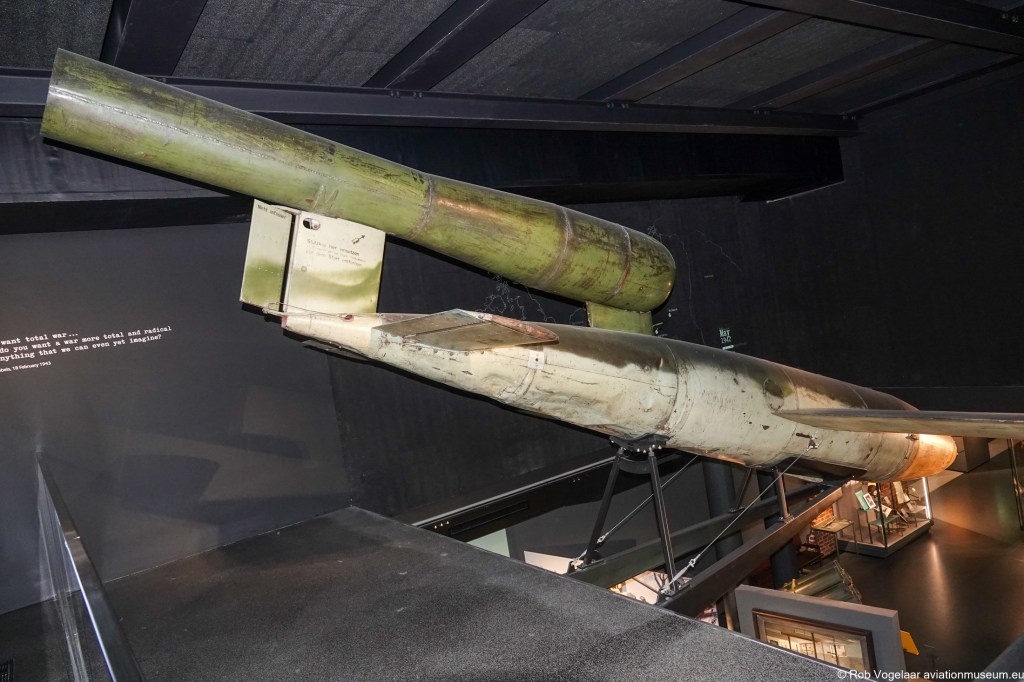
In 1942, Adolf Hitler’s demand for “terror attacks” against Great Britain led to a rapid acceleration in the development and production of German guided missile. The V1 (Vergeltungwaffe 1 – Reprisal Weapon 1) was at the forefront of this programme, but design faults and pre-emptive Allied air raids on vital installations ensured that it did not enter operational service until June 1944. Over the next 10 months, 10,492 flying bombs were launched against Britain resulting in 24,165 casualties and extensive damage to property. The devastation would have been much greater but for effective British anti-aircraft defence and intelligence operations. Although the V1 offensive continued after D-Day with attacks on liberated cities such as Antwerp, the Allied advance denied the Germans their launching sites in France and Belgium, forcing them increasingly to use Heinkel He111 bombers to air-launch the V1s against targets in Britain.
The V1 flying bomb was powered by an Argus 109-014 pulse-jet engine, carried a warhead of approximately 850kg, and was guided to its target by an autopilot. The maximum range was typically 149 miles (240km), with a maximum speed of 400mph (645kph), and this particular version has a span of 5.3m. Although some V1s were air-launched, most were catapulted from specially constructed ramps. The history of this particular V1 is not known but it was acquired by the Museum in 1946, and retains its original wartime paintwork.
The Awkward (and Tragic) Story
Its production led to more deaths than the bombings themselves.
Why?
1 – The V-1 bombs were built in Mittelwerk, an underground factory in Germany.
2 – This factory relied on forced labor, mainly prisoners from the Mittelbau-Dora concentration camp (a subcamp of Buchenwald).
3 – These prisoners worked in horrible conditions, with little food, constant abuse, and dangerous tasks.
4 – Many died from exhaustion, malnutrition, disease, and mistreatment.
5 – Some estimates suggest over 10,000 people died in the factory, more than the V-1 attacks killed.
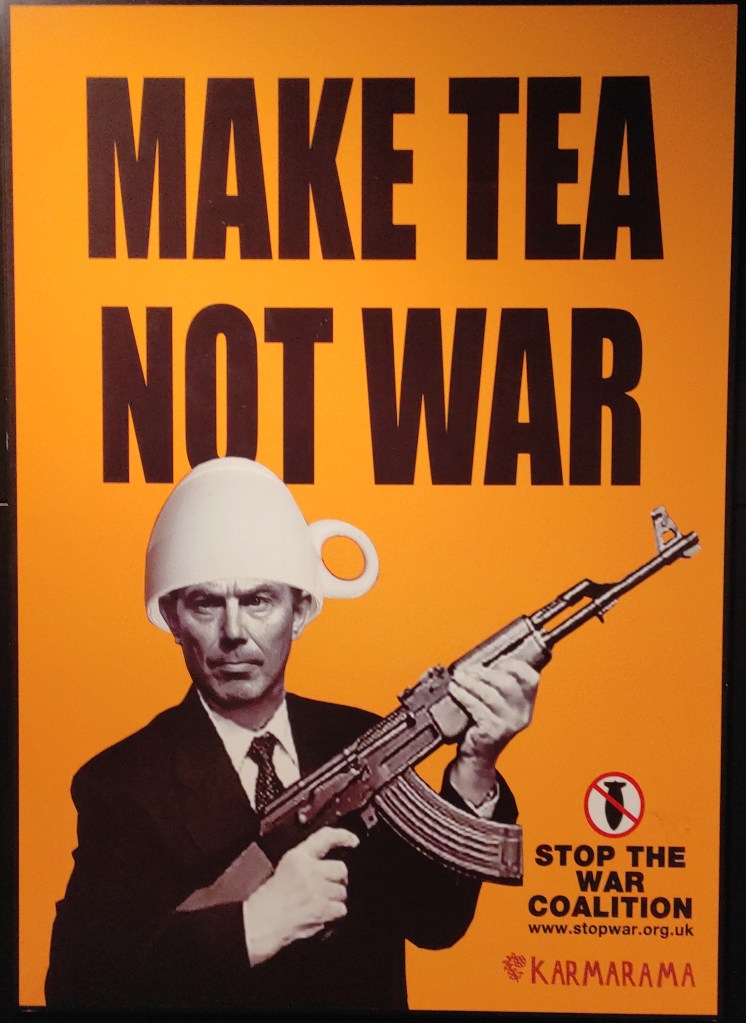
I spent more than four hours in the museum. I took so many photos – shame on me!

In the next post, I will share the second part of my third day – the visit to the Tower of London.
Do you need more information about the IWM?
- AviationMuseum https://www.aviationmuseum.eu/Blogvorm/imperial-war-museum-london/
- Imperial War Museum London https://www.iwm.org.uk/

 Precious Abstraction
Leave a comment